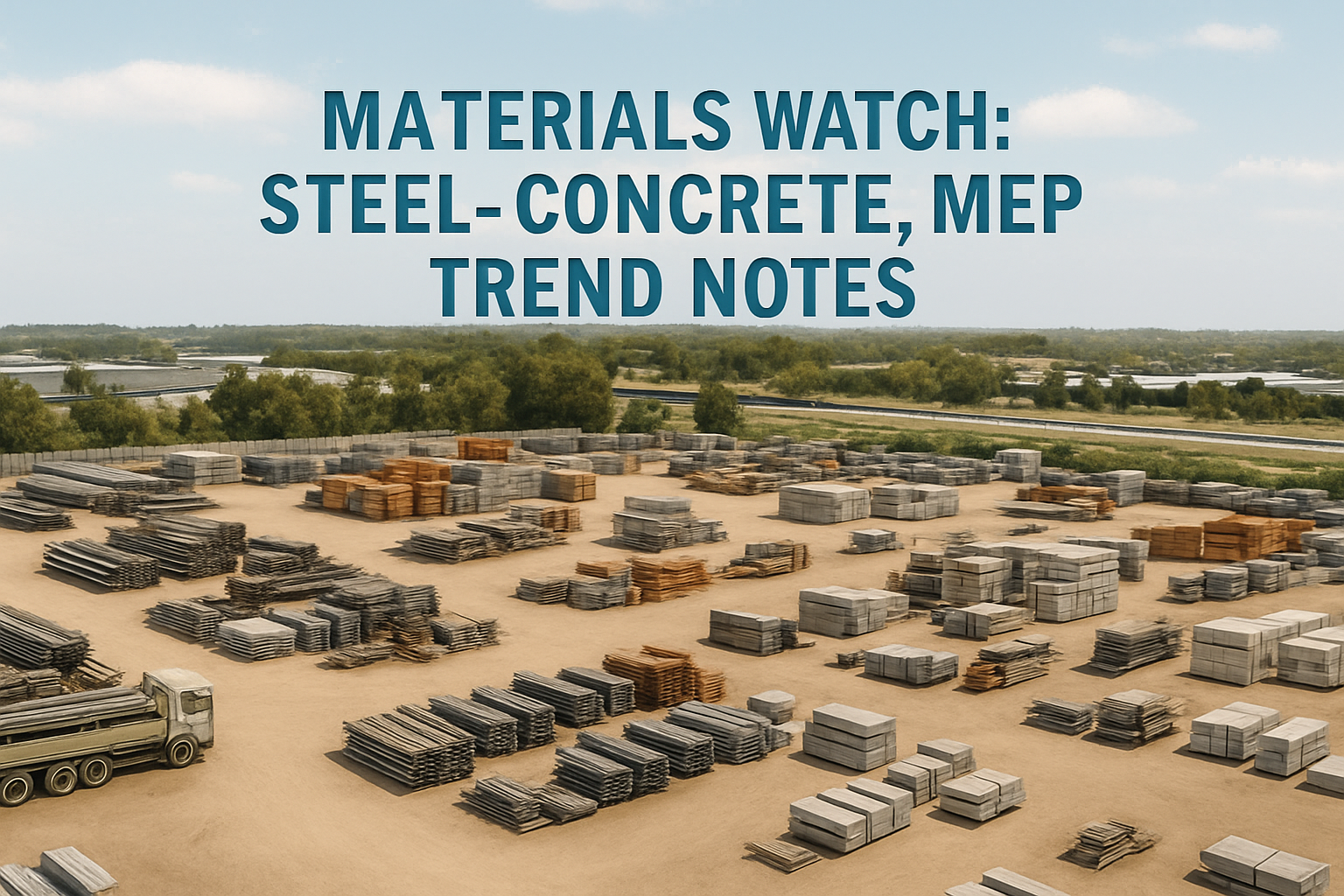
Materials Watch: Steel, Concrete, MEP – Trend Notes
Current trends in steel, concrete and MEP show stabilising material costs but continued labour-driven pressure. Official data highlights where risks remain.
Steel market: stabilisation with pockets of volatility
After two years of elevated global steel prices driven by freight disruption, energy costs and supply-chain imbalance, domestic steel indicators suggest a period of relative stability through 2025. ABS price indexes for structural steel products show year-on-year movements flattening into low single-digit ranges, a marked shift from the double-digit spikes seen during 2021–22. (ABS, 2024a)
Australia’s exposure to global billet and coil movements remains significant, and the pricing outlook still depends heavily on Asia-Pacific demand cycles and shipping costs. However, government data indicates improved supply reliability across ports and freight networks, reducing the risk of sudden step-changes that affected tenders in previous years. (BITRE, 2024)
Lead times for common structural sections have normalised across major distributors, though larger plate and specialist rolled products continue to show variability. Projects with heavy steel packages should continue to allow for moderate escalation, but the conditions are more stable than the last major pricing surge. (ABS, 2024a)
Concrete: mixed signals in cement, aggregates and ready-mix
Concrete pricing continues to reflect the dynamics of both materials and logistics. ABS Producer Price Indexes show underlying increases in cement and concrete products in the low-to-mid single digits, driven by energy costs and ongoing transport pressures rather than raw material scarcity. (ABS, 2024b)
Demand-side pressure is still uneven across the country. Infrastructure Australia notes that strong public infrastructure delivery in several states continues to pull heavily on quarry outputs, batch plant capacity and haulage, elevating localised pricing where multiple major projects overlap. (Infrastructure Australia, 2024)
Transport distance remains a key cost driver. Government guidance indicates that haulage for aggregates and premix accounts for a significant share of final concrete cost, and this proportion increases sharply outside metropolitan areas. As a result, regional projects often see materially higher delivered rates even when base material costs are similar. (BITRE, 2024)
MEP (Mechanical, Electrical, Plumbing): labour-heavy and supply-sensitive
MEP packages continue to experience upward pressure, predominantly from labour, while material costs have been more stable. Jobs and Skills Australia reports that key electrical, mechanical and plumbing trades remain in national shortage, keeping wage-driven cost escalation above general inflation. (Jobs and Skills Australia, 2024a)
ABS data on electrical equipment and HVAC components shows modest price movement overall, though imports remain sensitive to exchange rate fluctuations and global semiconductor supply. Lead times for specialised mechanical plant have improved compared with 2022–23 but still require early procurement on large projects. (ABS, 2024c)
Infrastructure Australia continues to highlight the impact of national construction workforce shortages on building services trades, especially on major infrastructure and healthcare projects where complex MEP systems dominate the scope. These shortages often translate into conservative productivity assumptions and higher risk allowances in tender pricing. (Infrastructure Australia, 2024)
What these trends mean for current projects
Steel and concrete have shifted into a period of relative stability, but remain exposed to international shipping, energy costs and state-by-state demand cycles. MEP, by contrast, continues to behave as the most labour-intensive and risk-sensitive set of packages, with tendered rates more affected by workforce availability than by material volatility.
For project teams, the most reliable approach is to anchor allowances to official government data and cross-check assumptions with live market soundings. Early procurement, transparent escalation modelling and sensitivity testing across freight, labour and lead times will provide the clearest picture of where real risks sit in 2025.
These trends should be read as broad signals rather than precise forecasts. Material markets respond to global and domestic influences, and local tender conditions remain the strongest determinant of final pricing.
Sources
- Australian Bureau of Statistics – Producer Price Indexes
- Australian Bureau of Statistics – Steel & Construction Material Indexes
- Bureau of Infrastructure and Transport Research Economics (BITRE) – Freight & Transport Data
- Infrastructure Australia – Infrastructure Market Capacity Reports
- Jobs and Skills Australia – Labour Market & Skills Priority Data
this article provides general information only and does not constitute financial, commercial or legal advice.
Need a project-specific cost read?
Our team can convert these market signals into scenario-tested allowances for your live pipeline and tender program.
More insights
12/12/2025
Metro vs Regional: The Hidden Drivers of Construction Cost Gaps
Same drawings, different postcode, different price. West-Edge explores the structural reasons behind metro–regional cost dif…
07/12/2025
2025/26 Construction Cost Outlook (Australia)
Summary: 2025/26 Construction Cost Outlook (Australia) Australia’s construction market in 2025/26 is steadier than recent ye…
11/11/2025
CostX Custom Reports for NAV Integration | West-Edge
West-Edge designs PascalScript-powered CostX custom reports that produce client PDFs and NAV/Business Central–ready Excel ex…