Metro vs Regional: The Hidden Drivers of Construction Cost Gaps
Same drawings, different postcode, different price. West-Edge explores the structural reasons behind metro–regional cost differences, from labour shortages and regional price indices to distance, risk and government-funded project pipelines.
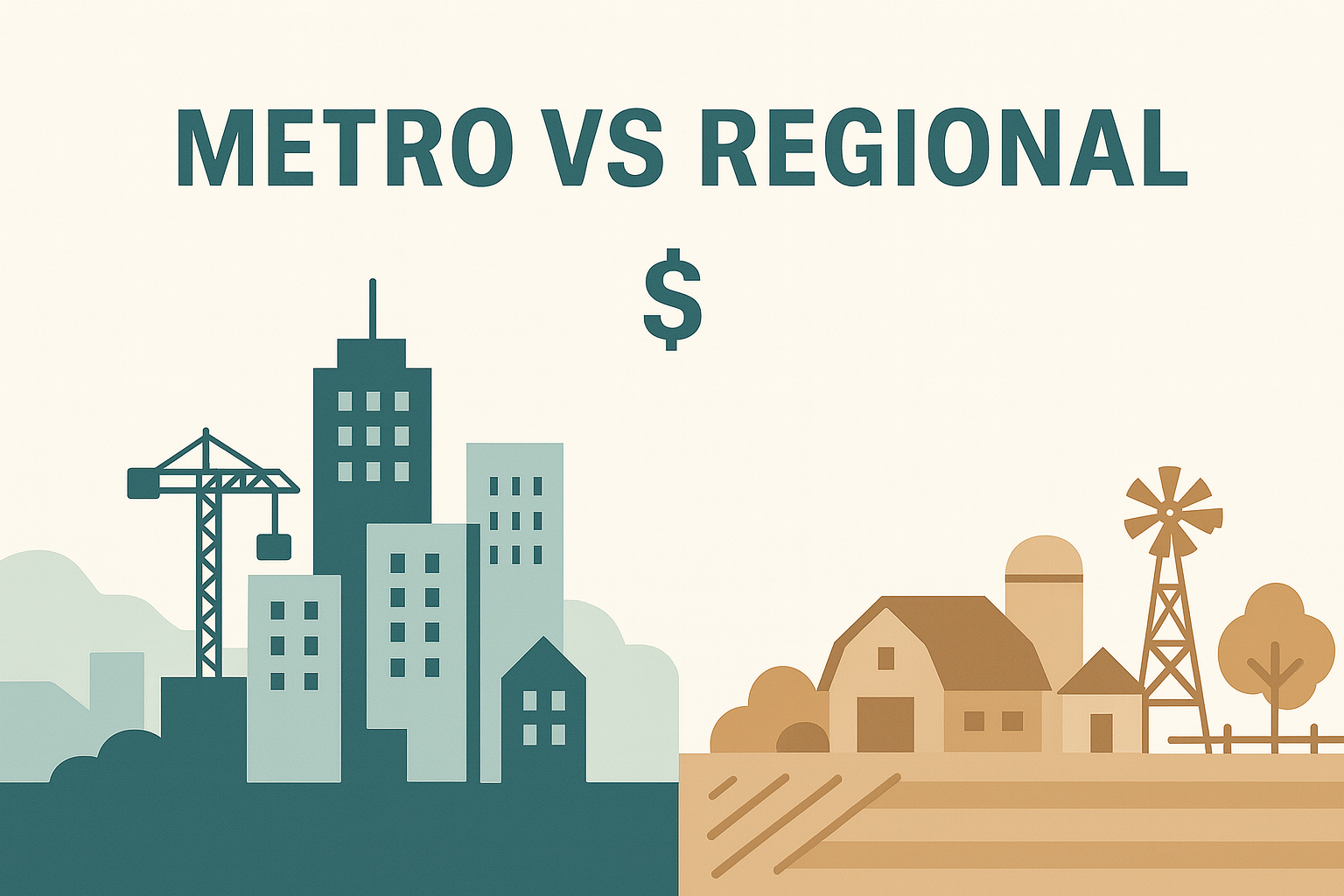
Metro vs Regional: The Hidden Drivers of Construction Cost Gaps
Clients are often surprised when the same set of drawings prices higher in a regional centre than in metropolitan Melbourne. The gap usually isn’t about “fat in the estimate” – it’s about how labour, logistics and risk behave differently outside the big cities. (VicGov, 2024a)
Good cost planning should explain that gap in plain language, backed by data. The aim is to help project teams understand why a regional price is higher, so they can decide whether to change scope, staging or timing – not just feel like they are being “penalised” for building outside the city. (VicGov, 2024a)
Where the workers actually are
Government labour market data shows how unevenly the construction workforce is distributed across Victoria. The State of the Victorian Labour Market Report 2024 notes that workforce shortages are more pronounced in regional areas than in metropolitan Melbourne, with a higher proportion of occupations assessed as being at risk of shortage. (VicGov, 2024a)
The same publication indicates that the majority of new workers entering the Victorian labour market between 2024 and 2027 are expected to be based in metropolitan Melbourne, with only around 19–20% in regional Victoria. Construction sits among the top growth industries in both metro and regional areas, which intensifies competition for skilled trades in regional centres. (VicGov, 2024b)
In practice, this translates directly into cost differences on real projects. Regional jobs often need to attract metro-based trades with travel, accommodation and time-away-from-home allowances on top of standard rates. Where the workforce is thin, contractors also price in productivity loss and the risk of not being able to fully staff the job for the duration of the programme.
Input prices don’t stand still across the map
It isn’t just labour. State governments actively track how the cost of everyday goods and services shifts between metropolitan and regional locations. For illustration, Western Australia’s Regional Price Index compares a standard “basket” of goods and services in regional areas against the Perth metropolitan baseline and shows that relative prices vary materially between regions. (WA Govt, 2023)
While these indexes are not construction-specific, they are a useful proxy for underlying pressures on things like fuel, accommodation and local services.Those pressures typically surface in preliminaries, freight, plant mobilisation and site establishment – all of which scale differently once you move away from a capital city. Two bids with identical trade break-ups can still differ simply because one builder is moving people, plant and materials much further.
Distance, complexity and risk
National infrastructure agencies are equally clear about the challenge. Infrastructure Australia highlights that high construction costs are a major issue for small towns, rural and remote areas. The causes are familiar to anyone who has delivered regional work: long distances, low population densities, limited local workforces, difficulty attracting workers, and greater exposure to extreme weather and climate risks. (Infrastructure Australia, 2023a)
Infrastructure Australia’s Infrastructure Market Capacity reporting also points to a very large public infrastructure pipeline over the next few years and warns that construction workforce shortages could reach hundreds of thousands of workers nationally. In practical terms, this means regional projects are competing in the same national labour and materials pool as mega-projects in the capitals. (Infrastructure Australia, 2023b)
When contractors see distance, limited back-up options and climate risk, they respond with higher contingencies, more conservative productivity allowances and tougher programme assumptions. None of these are “nice to have” cost items – they are rational responses to genuine risk.
How government funding interacts with market pricing
Governments at all levels are trying to narrow the regional infrastructure gap. The Australian Government’s Growing Regions Program, for instance, is providing hundreds of millions of dollars in capital funding for projects in regional, rural and remote communities across Australia, with dozens of projects supported in each funding round. (AusGov GRP, 2024)
The investment pipeline can be a double-edged sword. It significantly improves regional amenity, but it also puts sustained pressure on local capacity. When a town suddenly has multiple funded projects running at once, bids can jump simply because there are more live opportunities than available crews to deliver them. This often shows up in tender feedback, where contractors talk openly about “choosing” the projects that best suit their resources. (Infrastructure Australia, 2023a)
What this means for your project
For owners and project teams, the key takeaway is that scope parity does not imply price parity between metro and regional locations.
In practice, more robust regional cost planning tends to:
- Use government and other official data as the evidence base for regional allowances and escalation (VicGov, 2024a).
- Stress-test labour and logistics assumptions through local market soundings and contractor conversations (VicGov, 2024b).
- Separate “pure scope” costs from region-specific loadings, so decision-makers can clearly see what is driving the gap.
- Run sensitivity scenarios – for example, different construction windows or staging options – to test how much of the premium is truly unavoidable.
Taken together, these practices recognise that regional projects are not “too expensive by default” – they are simply exposed to a different set of market forces. Transparent allowance building, early engagement with contractors and realistic programming can narrow the gap, even if it cannot be removed entirely.
Sources
- Victorian Government – Workforce shortages more pronounced in regional Victoria
- Victorian Government – Strong demand for workers in metro & regional Victoria to 2027
- Western Australia – Regional Price Index
- Infrastructure Australia – Regional infrastructure challenges & opportunities
- Infrastructure Australia – Infrastructure Market Capacity
- Australian Government – Growing Regions Program
Need a project-specific cost read?
Our team can convert these market signals into scenario-tested allowances for your live pipeline and tender program.
More insights

15/12/2025
Materials Watch: Steel, Concrete, MEP – Trend Notes
Current trends in steel, concrete and MEP show stabilising material costs but continued labour-driven pressure. Official dat…
07/12/2025
2025/26 Construction Cost Outlook (Australia)
Summary: 2025/26 Construction Cost Outlook (Australia) Australia’s construction market in 2025/26 is steadier than recent ye…
11/11/2025
CostX Custom Reports for NAV Integration | West-Edge
West-Edge designs PascalScript-powered CostX custom reports that produce client PDFs and NAV/Business Central–ready Excel ex…